American Data Centers Supporting Cloud Gaming See Increased Demand for Liquid Cooling Systems Tailored to Graphics Processing Clusters
Sage Schulz · Jun 11, 2026
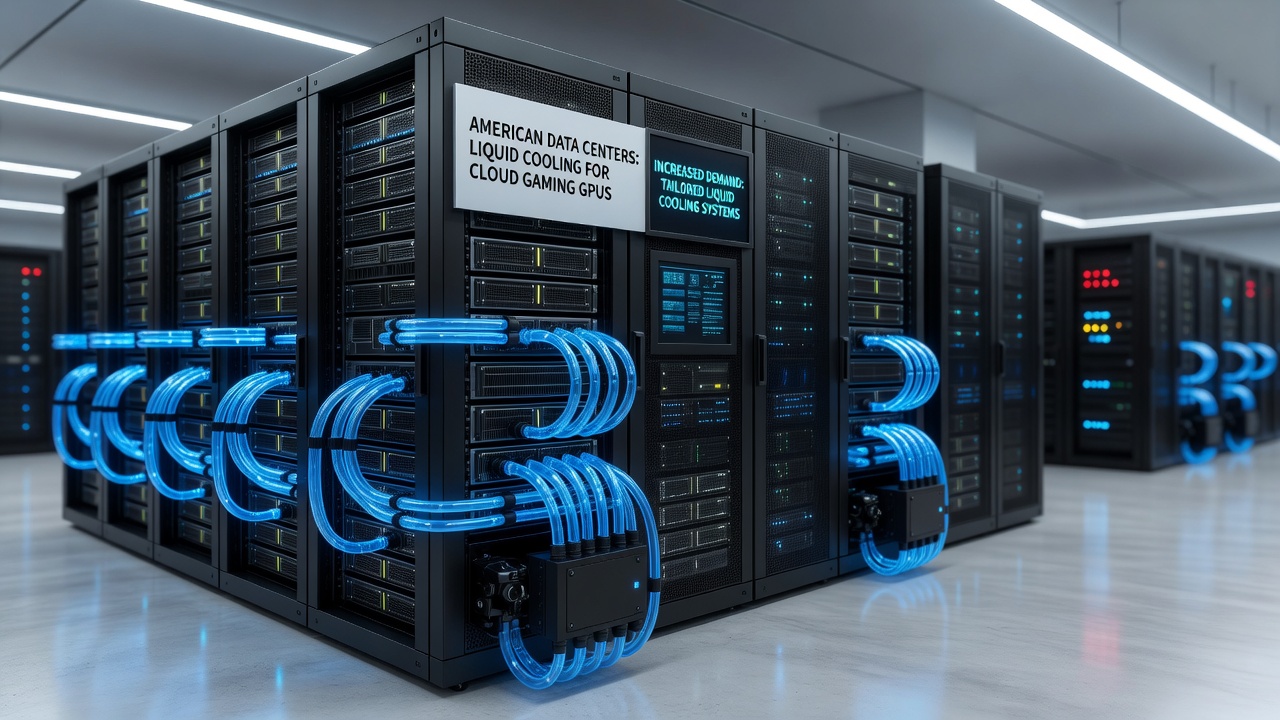
American Data Centers Supporting Cloud Gaming See Increased Demand for Liquid Cooling Systems Tailored to Graphics Processing Clusters
American data centers that power cloud gaming platforms continue to expand their infrastructure to handle growing user demand for high-performance streaming, and this expansion drives a measurable shift toward liquid cooling solutions designed specifically for dense graphics processing clusters. Facilities across states such as Virginia, Texas, and Oregon report higher rack densities as operators add more GPUs to support simultaneous game sessions at 4K and higher resolutions with minimal latency.
Cloud gaming services rely on centralized rendering farms where hundreds or thousands of GPUs process frames in real time before transmitting them over networks to end users, and these workloads generate concentrated heat loads that exceed the practical limits of traditional air cooling in many installations. Data from industry monitoring groups shows average power densities per rack climbing past 40 kilowatts in gaming-focused zones, prompting operators to adopt direct-to-chip and immersion-based liquid systems that transfer heat more efficiently through closed-loop fluid circulation.
Key Factors Behind Rising Cooling Demand
Market growth for subscription-based cloud gaming has accelerated GPU deployment schedules, with providers scaling clusters to accommodate peak evening traffic across multiple time zones, and this pattern requires cooling architectures that maintain stable temperatures without excessive energy overhead. One facility operator in Northern Virginia noted that liquid cooling retrofits allowed an additional 25 percent GPU capacity within existing floor space while keeping inlet temperatures below thresholds that trigger thermal throttling during extended sessions.
Graphics processing units used in these environments run at sustained high utilization rates, often above 90 percent during multiplayer titles, which produces heat profiles that vary sharply across individual dies and memory modules, and tailored liquid cooling plates address these variations through microchannel designs matched to specific GPU architectures from major vendors. Research compiled by the National Renewable Energy Laboratory indicates that optimized liquid systems can reduce cooling energy consumption by up to 40 percent compared with raised-floor air handlers in equivalent high-density deployments.
Technical Adaptations for GPU Clusters
Liquid cooling implementations in gaming data centers typically combine cold-plate assemblies mounted directly on GPU packages with manifold distribution networks that circulate dielectric fluids or treated water at controlled flow rates, and these setups integrate sensors that adjust pump speeds based on real-time thermal telemetry from each node. Cluster-level controllers coordinate flow across dozens of servers to prevent hotspots while minimizing overall pump power draw during off-peak periods.
Operators also incorporate hybrid approaches that pair liquid loops with targeted air assist for power supply units and networking equipment, creating balanced thermal management across mixed hardware racks, and such configurations appear in new builds completed during the first half of 2026. Facilities report that GPU-specific cold plates reduce junction temperatures by 15 to 20 degrees Celsius under load compared with air-cooled equivalents, allowing sustained boost clocks without performance caps.
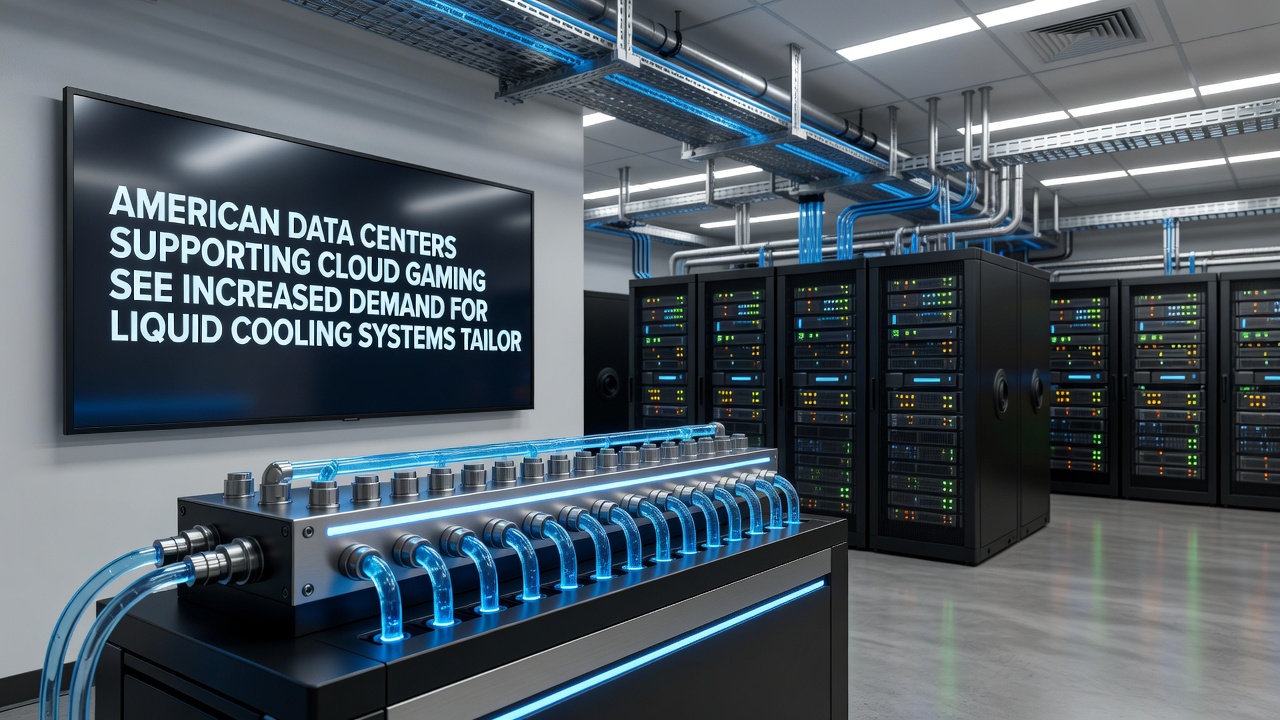
Regional Deployment Patterns Across the United States
Texas-based campuses have emerged as early adopters because abundant land and power availability support rapid cluster expansion, while Pacific Northwest sites leverage cooler ambient conditions to reduce chiller loads when paired with liquid loops that reject heat through dry coolers during much of the year. Midwest facilities, meanwhile, focus on modular liquid systems that permit phased rollouts as gaming traffic scales.
According to figures released by the U.S. Department of Energy, data center electricity use tied to cooling represents between 30 and 40 percent of total facility consumption in air-dominant setups, and liquid cooling retrofits have begun narrowing that share in gaming-oriented zones where GPU density exceeds 10 units per rack. U.S. Department of Energy analysis highlights case studies where liquid-assisted designs maintained performance metrics during summer peaks without proportional increases in utility demand.
Integration Challenges and Solutions
Transitioning existing air-cooled halls to liquid systems involves careful planning around leak detection, fluid compatibility, and maintenance access, yet several operators completed partial conversions by mid-2026 without extended downtime. Redundant pumps, quick-disconnect fittings, and automated shutoff valves now form standard safety layers that address concerns around fluid management in live environments.
Training programs for technicians emphasize diagnostics specific to liquid loops, including flow meter calibration and corrosion monitoring, while vendors supply pre-engineered manifold kits sized for common GPU server chassis. These standardized components speed deployment across multiple sites operated by the same cloud gaming provider.
Outlook Through Mid-2026 and Beyond
Projections compiled through industry surveys point to continued growth in liquid cooling adoption as GPU generations advance toward higher thermal design power envelopes, and facilities built after June 2026 increasingly specify liquid-ready infrastructure from the initial design phase rather than retrofitting later. Academic studies from institutions tracking high-performance computing trends reinforce that fluid-based thermal management scales more predictably when rack densities push past current levels.
Collaboration between cooling equipment manufacturers and GPU designers has produced reference architectures that align cold plate geometry with upcoming chip layouts, reducing custom engineering time for each new cluster generation. Data centers supporting cloud gaming therefore gain both capacity and efficiency advantages as these integrated solutions roll out.
Conclusion
The combination of expanding cloud gaming workloads and concentrated GPU heat output has established liquid cooling as a practical requirement in American data centers rather than an optional upgrade, and ongoing refinements in system design continue to support higher densities while controlling energy use. Facilities that implement tailored solutions for graphics processing clusters demonstrate measurable improvements in thermal stability and operational flexibility as demand patterns evolve through 2026 and subsequent years.