Arid Western Climates Challenge Gaming Hardware Durability Across Desert States
Xander Carter · Aug 22, 2026

Arid Western Climates Challenge Gaming Hardware Durability Across Desert States
Arid regions spanning Arizona, Nevada, New Mexico, Utah, and portions of California and Colorado present distinct environmental pressures on gaming hardware, where elevated temperatures, low humidity levels, and airborne particulates interact with electronic components daily. Data from the National Oceanic and Atmospheric Administration indicate average summer highs in these zones frequently exceed 100 degrees Fahrenheit, creating sustained thermal loads on processors, graphics cards, and power supplies used in desktop rigs and consoles alike. Researchers at Arizona State University documented accelerated thermal cycling in electronics exposed to such conditions, noting that repeated expansion and contraction of solder joints leads to microfractures over multi-year periods.
Temperature Extremes and Component Degradation
High ambient heat forces cooling systems in gaming laptops and PCs to operate at elevated fan speeds for extended durations, which increases mechanical wear on bearings and motors according to benchmarks compiled by the University of Nevada, Reno engineering department. Graphics processing units in particular experience junction temperatures that climb beyond manufacturer specifications during marathon sessions, prompting thermal throttling that reduces performance while shortening the operational window before permanent silicon degradation sets in. Observers note that consoles placed near windows or in poorly ventilated rooms accumulate heat buildup faster in these climates, with internal sensors logging higher baseline readings year-round compared to coastal installations.
Low Humidity and Static Electricity Risks
Relative humidity often drops below 20 percent across the Southwest for months at a time, elevating static discharge potential around sensitive circuits in controllers, motherboards, and solid-state drives. Studies conducted by the Desert Research Institute in 2025 recorded static voltage spikes capable of damaging integrated circuits when users interact with hardware during dry winter periods. Dust particles carried by regional winds compound the issue, settling on printed circuit boards and forming insulating layers that impede heat dissipation from voltage regulators and memory modules.
Dust Accumulation and Airflow Restrictions
Airborne sediment in states like New Mexico and western Texas clogs intake vents and radiator fins within weeks of initial setup, according to field measurements shared by the Environmental Protection Agency's regional monitoring stations. This restriction reduces airflow efficiency, forcing fans to spin faster and consume additional power while generating excess noise. One study tracking PC builds in Phoenix households found filter replacements needed every 45 days on average during peak dust seasons, versus quarterly intervals reported in more humid Midwest locations.
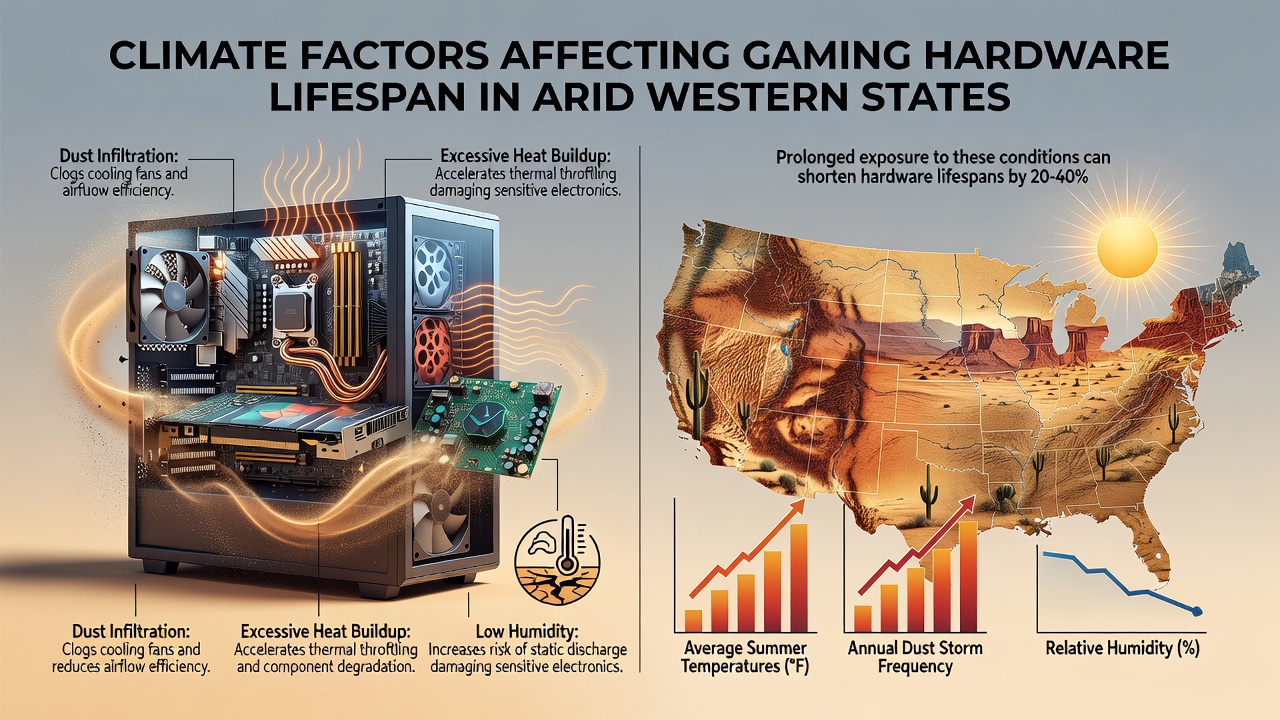
Graphics card fans and CPU coolers suffer the most visible effects, with impeller blades collecting fine silt that imbalances rotation and accelerates bearing failure. Data centers supporting cloud gaming services in these areas have reported similar patterns, leading operators to install enhanced filtration systems that add measurable overhead to overall energy consumption.
Regional Data and Hardware Performance Trends
Figures released by the Western Regional Climate Center for August 2026 show sustained drought conditions persisting across the Colorado Plateau and Great Basin, correlating with increased reports of hardware failures logged through manufacturer warranty databases. Gaming laptops transported between air-conditioned interiors and outdoor environments experience rapid condensation cycles when humidity briefly rises, introducing moisture into previously dry enclosures. Industry reports from the Semiconductor Industry Association highlight that memory modules and solid-state drives exhibit higher failure rates in environments where daily temperature swings exceed 40 degrees Fahrenheit, a common occurrence in high-desert locales.
Take one longitudinal project at the University of Colorado Boulder that monitored 200 gaming stations over 18 months, revealing that systems without supplemental air filtration required component replacements 30 percent sooner than comparable units in controlled laboratory settings. External links to broader climate datasets from the Australian Bureau of Meteorology offer comparative insights into how similar arid conditions affect electronics elsewhere, while the European Environment Agency provides parallel findings on heat stress in southern European data facilities.
Long-Term Lifespan Implications
Battery cells in portable devices degrade faster under combined heat and low-humidity stress, with lithium-ion capacity retention dropping measurably after repeated exposure to 95-plus degree environments. Power supply units face elevated ripple currents when operating near thermal limits, which stresses capacitors and leads to earlier replacement cycles as documented in IEEE conference proceedings from 2024 through 2026. Those tracking esports facility maintenance in Las Vegas and Albuquerque note that modular component swaps occur more frequently in these markets than national averages would predict.
Conclusion
Climate factors in arid western states create measurable, cumulative effects on gaming hardware through sustained thermal loads, static risks, and particulate infiltration that collectively reduce operational lifespans compared to milder regions. Ongoing monitoring by academic and government institutions continues to quantify these interactions as hardware evolves and regional conditions shift.