US Gaming Firms Explore Adaptive Cooling Solutions for Dense Esports Venue Hardware Clusters Amid Rising Event Scales
Avery Schmitt · Jul 9, 2026
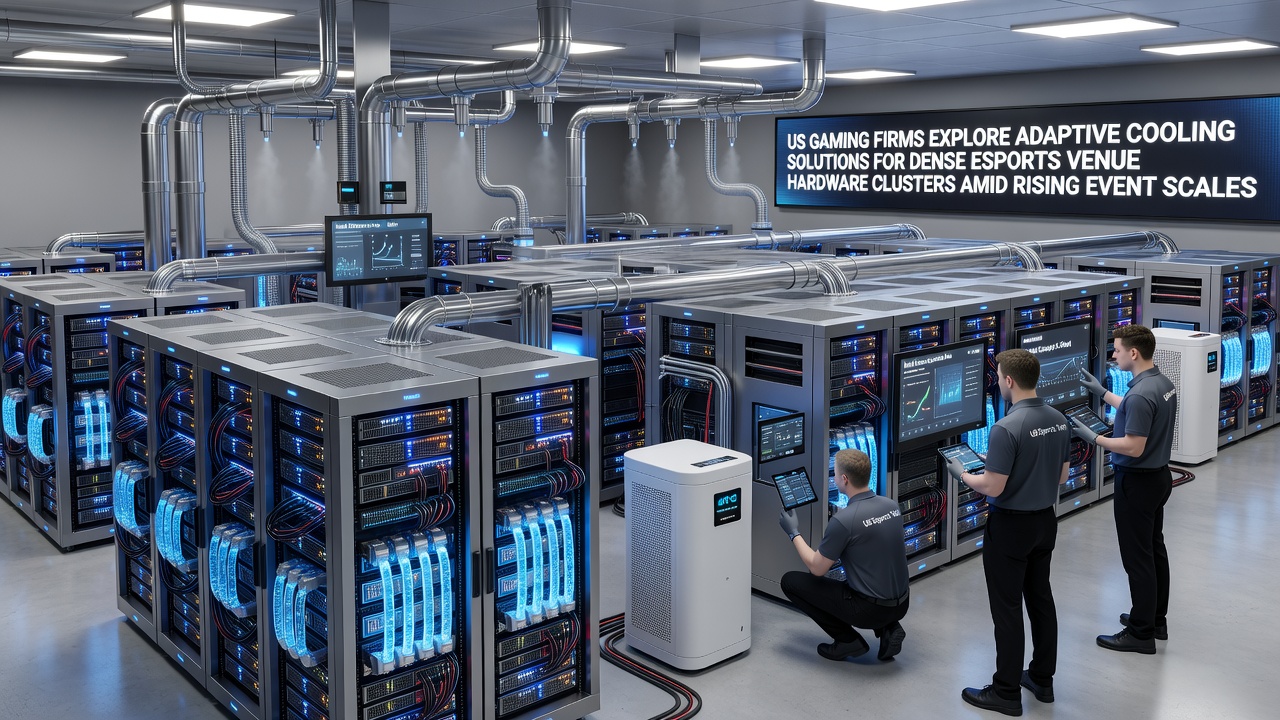
US Gaming Firms Explore Adaptive Cooling Solutions for Dense Esports Venue Hardware Clusters Amid Rising Event Scales
US gaming firms have turned attention toward adaptive cooling solutions as esports events expand in scale and hardware density increases within venue setups, with multiple companies deploying systems that adjust in real time to heat loads generated by clustered gaming rigs and servers. Event organizers report that tournament footprints now routinely incorporate hundreds of high-performance units in single arenas, a shift driven by larger participant numbers and streaming demands that have grown steadily through 2025 and into July 2026.
Hardware clusters in these venues typically combine gaming PCs, networking switches, capture systems, and rendering servers, all operating under continuous loads during multi-day competitions. Traditional air conditioning approaches often fall short when rack densities exceed standard thresholds, prompting firms to test liquid-based and hybrid methods that respond dynamically to temperature spikes detected across sensor arrays.
Hardware Density Trends in Expanding Esports Events
Industry data shows average hardware counts per major venue have risen from roughly 150 units in 2022 events to over 400 in recent competitions, according to reports compiled by the Entertainment Software Association. This growth stems from expanded bracket sizes, simultaneous matches across multiple stages, and integration of virtual production tools that require additional processing power. Observers note that venues such as those hosting League of Legends Championship Series finals and Valorant Masters events now allocate dedicated server rooms alongside main stages, creating localized heat zones that demand targeted cooling rather than uniform facility-wide climate control.
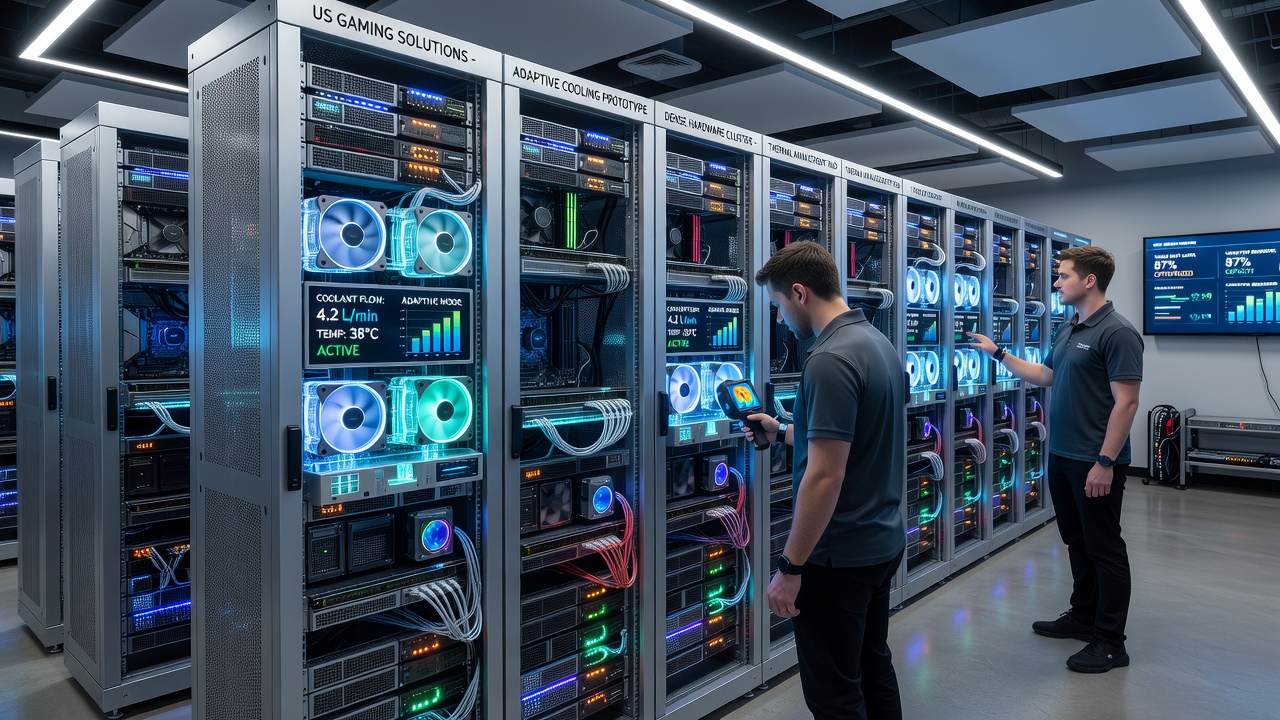
Adaptive systems under evaluation include variable-speed liquid loops paired with AI-driven monitoring software, which reroutes coolant flow based on individual component temperatures rather than fixed schedules. Several US-based developers have partnered with cooling specialists to integrate these controls directly into venue infrastructure, allowing operators to scale capacity up during peak match hours and reduce output during downtime periods.
Technologies Under Active Development
One approach gaining traction involves immersion cooling tanks sized for groups of 20 to 30 units, where dielectric fluids absorb heat before circulation through external heat exchangers. Companies testing this method report stable operation at power densities above 30 kilowatts per rack, a threshold common in current esports builds. Another pathway uses direct-to-chip liquid plates connected to facility water loops, with adaptive valves that modulate flow rates in response to load sensors embedded in each GPU and CPU assembly.
Research from the US Department of Energy highlights efficiency gains when such variable systems replace constant-flow setups, noting reductions in overall energy draw for equivalent cooling output. Firms have also explored phase-change materials layered within rack enclosures to buffer short-term thermal spikes during sudden increases in processing demand, such as when multiple broadcast feeds activate simultaneously.
Implementation Examples Across Venues
Take one facility in Los Angeles that integrated sensor networks across 12 server racks during a 2025 summer event series, allowing real-time adjustments that maintained component temperatures below 65 degrees Celsius even as ambient arena conditions fluctuated. Similar pilots have occurred in Dallas and Atlanta venues, where operators combined modular chiller units with predictive algorithms trained on historical tournament data. These setups permit preemptive cooling activation ahead of scheduled matches, reducing the lag between load increases and thermal response.
Canadian research institutions studying data center thermal management have shared findings with US partners on hybrid air-liquid configurations, emphasizing the value of zoned control that isolates cooling to high-density areas while maintaining standard HVAC for spectator zones. Such collaborations illustrate how cross-border data exchange supports domestic implementation without requiring entirely new infrastructure overhauls at each site.
Operational Considerations and Scaling Factors
Power delivery remains intertwined with cooling choices, since higher rack densities necessitate upgraded electrical feeds that must accommodate both compute loads and cooling equipment draw. Venue planners now factor adaptive cooling into initial site assessments, particularly when converting existing arenas or convention halls that were not originally designed for sustained high-density computing. Maintenance protocols have evolved as well, with firms scheduling fluid checks and sensor calibrations between event cycles to ensure consistent performance across successive tournaments.
Supply chain elements include specialized pumps, manifolds, and monitoring software sourced from domestic manufacturers, which helps align with regional availability constraints observed in recent years. Event organizers track these components alongside traditional hardware inventories, recognizing that cooling reliability directly influences uptime during live competitions where interruptions carry significant visibility.
Conclusion
US gaming firms continue refining adaptive cooling approaches to match the hardware demands of larger esports gatherings, integrating sensor-driven liquid systems and hybrid configurations that respond to real-time conditions within venue clusters. Data from ongoing deployments through July 2026 indicates measurable improvements in thermal stability and energy alignment compared with earlier fixed methods. As event scales expand further, these solutions form part of broader infrastructure planning that addresses both performance requirements and operational continuity across multiple locations nationwide.